
Concepts/Concept
ADPS Engineering Concept Registry
Responsibility Boundary Between the Orchestrator and MessageHandler
Keep control flow in the orchestrator and input/output presentation in the facade.
From the Dongfang Yiteng execution agent (case contributed by Bo Liang)
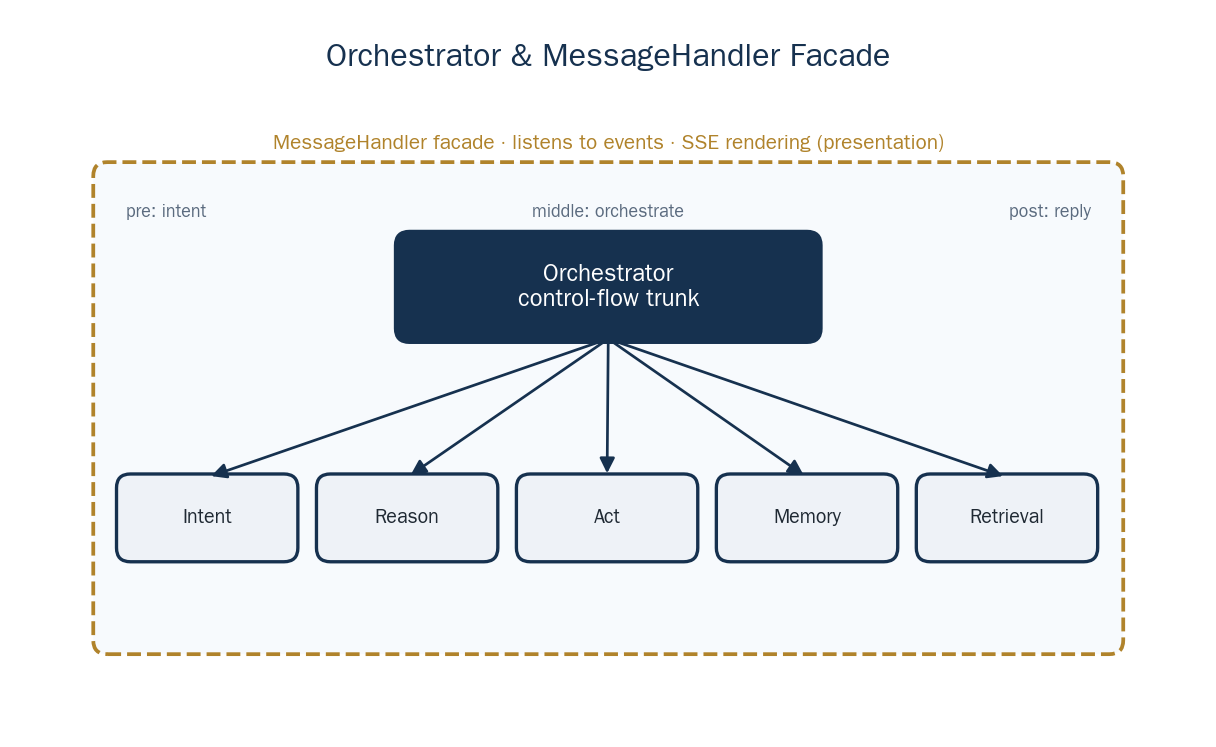
Application context: a browser reconnect must preserve task semantics
A user starts payroll configuration from a web interface and receives progress over SSE. If the page refreshes or the network reconnects, the backend task should continue from its prior state while the new connection replays visible events. When an input handler also owns the task graph, tool calls, and recovery, changing the transport can change execution behavior.
Runtime control should remain independent of Web, CLI, and messaging transports. The outer component handles protocol and presentation. The Orchestrator handles the task lifecycle.
Definition
The Orchestrator manages runtime control flow for a session. It consumes control signals, invokes reasoning, memory, retrieval, and action modules, and transfers control between them.
The MessageHandler is an outer facade. It receives user messages, calls the Orchestrator, subscribes to activity events, and streams progress and results to the interface through protocols such as SSE.
Engineering mechanism
| Component | Responsible for | Excludes |
|---|---|---|
| Orchestrator | Routing, capability orchestration, mode transitions, and completion decisions | UI rendering and typewriter effects |
| MessageHandler | Input adaptation, event subscription, and streaming output | Reasoning decisions and business scheduling |
The Orchestrator publishes Activity events with a stable schema and no dependency on a particular frontend. The MessageHandler converts those events into SSE messages. Dongfang Yiteng implements the publish-subscribe path with Go goroutines and channels.
The intent gateway sits inside or below the Orchestrator. It consumes control signals such as chat, analyze, resolve, and unknown, then selects an execution path. Session entry is the pre stage, capability orchestration is middle, and response synthesis is post.
Case usage
A payroll-group request enters intent classification during pre. The middle stage performs template matching, snapshot creation, and import. The post stage synthesizes the result. Each step emits events; the MessageHandler only presents them on the Web timeline.
Adding an action capability requires registering the capability and its control signals. Changing the Web presentation does not change orchestration logic.
Adoption conditions
Separate the Orchestrator from the input/output facade when an agent contains several capabilities, selects execution paths from control signals, and exposes the same run through different interfaces or protocols. See Intent as Compilation and Control and Narrative Planes for the source of those control signals.
Proposal and provenance
- Concept group
- System boundaries and state
- Initial source within ADPS
- Initial practice: Bo Liang
- First recorded in
- Dongfang Yiteng execution-agent case ()
- ADPS editorial work
- ADPS used the Facade, Mediator, and workflow-engine lineage to state the boundary between I/O adaptation and control.
- Current standing
- ADPS restatement
Initial source: Dongfang Yiteng Execution Agent case report; contributed by Bo Liang.
Chronicle
- Recorded source
- Dongfang Yiteng execution-agent case ()
- Source date
- First published on ADPS