Concepts/Concept

Anchor, Ledger, Collection: The Core Trio of the Narrative Plane

From the Dongfang Yiteng execution agent (case by Bo Liang)

Anchor, Ledger, Collection: the core trio of the narrative plane

Definition

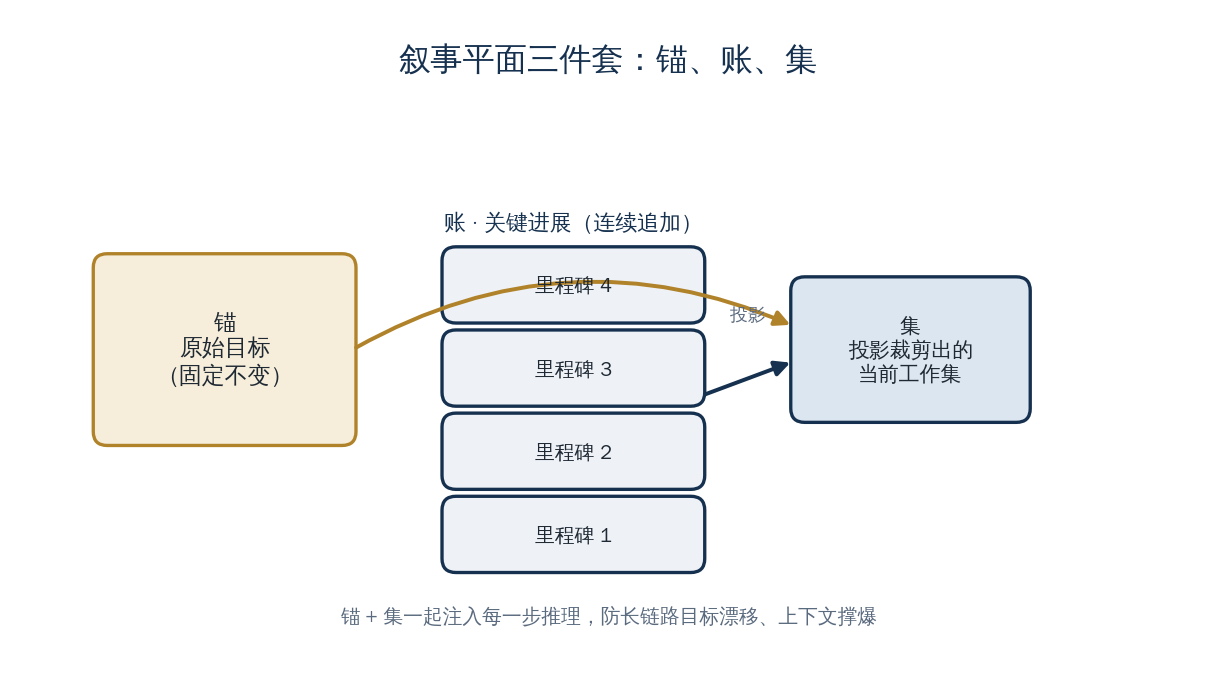
The core semantics of an execution-type agent's narrative plane can be summed up in one phrase: a description of goal and progress. It works like a continuously kept set of work notes — the agent records what it has done as it executes, while preserving the user's original goal at every step. These notes are made of three elements, which the team calls anchor, ledger, and collection.

The anchor anchors the original input of every session and conversation from the user, serving as the fixed top-level goal. In complex business scenarios the execution chain is long: from the entry point that receives the raw request, it passes through reasoning, action, and task planning, and the information is processed, expanded, or compacted as it moves downstream. If the narrative content is only a chained one-way pass where each step's output becomes the next step's input, a long path will gradually drift away from the original goal — by the task-planning stage, the input fed to the model may already have become the thoughts produced during reasoning, while the user's goal takes up only a small share. So in the context of every reasoning step, the user's original goal must be carried through as fixed data.

The ledger is a running record of key progress, kept as appended summaries. For each completed key milestone-level reasoning or action, a semantically compacted summary is written into it. A later step, while knowing the user's goal, must also know what was done before and what results were achieved, in order to reason out what this step should accomplish. The ledger answers "where it came from, where it has reached."

The collection is the temporary in-memory information cut out by distilling and projecting from the ledger once more at certain key reasoning points. Even though the ledger is already a compacted summary, a long chain still accumulates a long context, and the full content cannot be stuffed into the prompt. So at a key reasoning entry, a set of temporary information is projected and trimmed from the ledger according to the scenario being injected at that moment, and is injected into the current step together with the anchor.

The collection step can be understood through the act of taking over work. When you take over a task whose earlier steps were each completed by different colleagues, what you need to know is not every detail of each step, but which key milestones each of them completed — and only the few most relevant to the task in front of you. What an agent needs at a key reasoning point is exactly this kind of trimmed handover note: it captures the important prior progress without bloating the context with the full history.

How it works

What the trio is meant to guard against is goal drift over a long chain. The most typical case is the user's "continue." After one round of conversation completes and the user is asked whether to continue, the user's next turn is only the single word "continue." When the agent then starts to reason, it may already have drifted from the essential goal: either it cannot understand what "continue" refers to, or it acts directly on its own on-the-spot reading of "continue." The anchor pins the original goal into the context of every step, the ledger keeps the mid-course results from being lost, and the collection injects both at a controllable size — only then does "continue" have something to go on.

In Dongfang Yiteng's narrative state plane, the anchor and ledger are the persistent source of truth, while the collection is the working set projected temporarily at a key reasoning entry. The ledger keeps appending; the collection is cut on the spot each time, used, and discarded. This structure separates "the full history" from "what this step actually needs to look at," and stable delivery over a long execution chain rests on this separation.

When you need it

When your agent must deliver a multi-step task over a very long execution chain, and may be interrupted mid-course by a minimal instruction from the user such as "continue," chained context passing alone will gradually lose memory, and you need anchor, ledger, and collection to manage goal and progress explicitly.

Related concepts: unified session state and its separation of powers, memory envelope, L1/L2/L3 layered memory.


This is an ADPS blue-book concept. Back to Concepts or the pattern matrix.