
Bound the goal
One employee, one field, one effective date; no retroactive payroll change.
A public pattern language for production AI agent systems.
ADPS is an independent research community that publishes technical references for building production AI agent systems. We bring together software design research, open-source harness engineering, and attributed enterprise case reports to turn common architectural problems into reusable pattern specifications that engineering teams can adopt.
Cognitive functions × execution topologies
Functions define problems; topologies structure runtime; cross-cutting planes cover system-wide concerns.
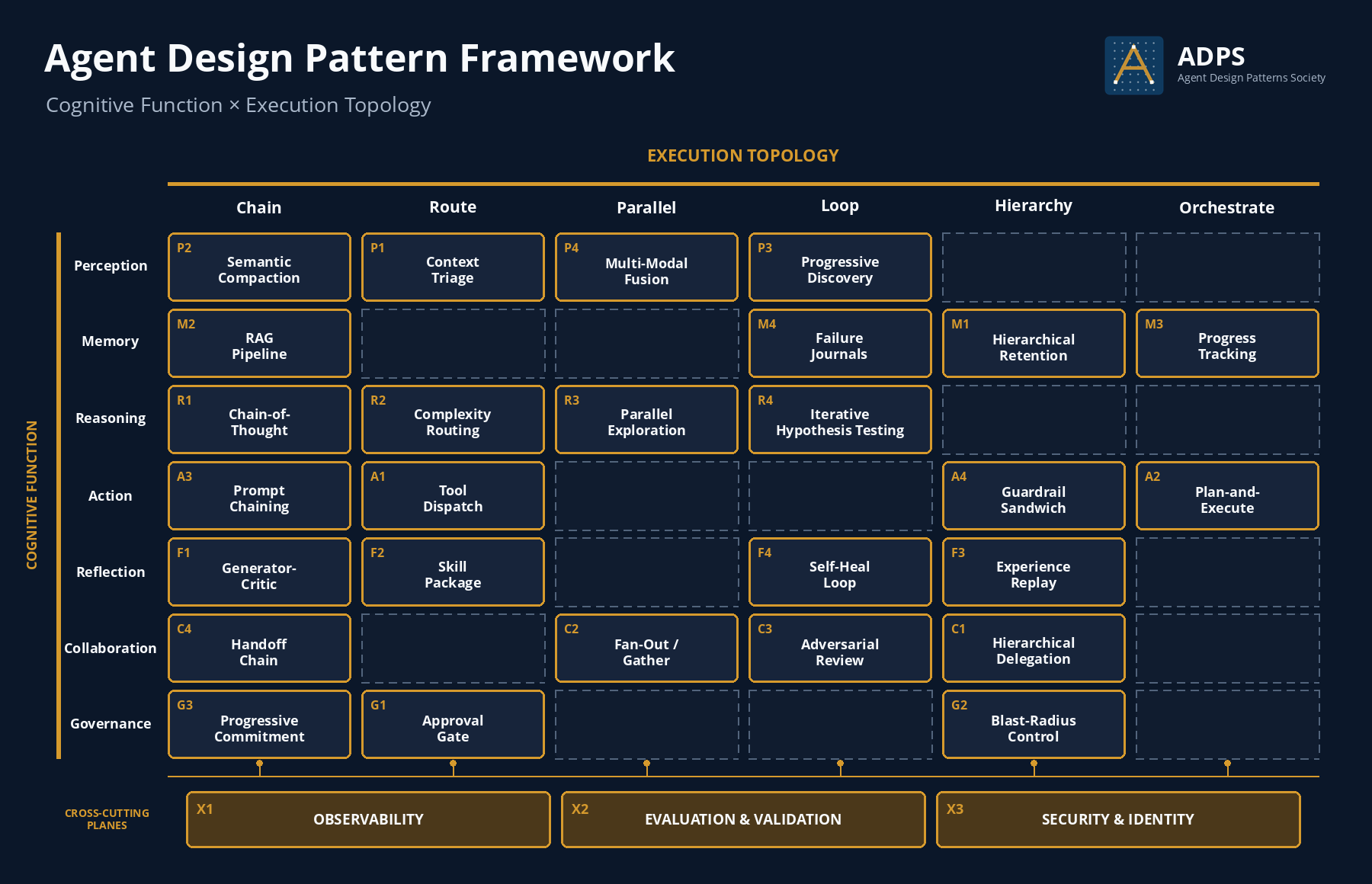
27 matrix patterns · 3 cross-cutting engineering planes
Start with one business change
Example request: “Change employee E-1842's monthly transport allowance from 800 to 1000, effective next month.” A model can understand the sentence. A production system must also establish the goal, facts, authority, action, and result.
One employee, one field, one effective date; no retroactive payroll change.
Current value comes from the HR API; policy comes from a versioned knowledge source.
Read, validate, prepare, approve, commit, and read back, each with a completion condition.
Tool, arguments, and resource become an Intent; review covers that exact content and one employee.
The transaction receipt and after-read must agree before the run can claim completion.
Split again when decision, approval, execution, acceptance, or compensation requires a different owner or rule. The boundary is small enough when each control can be assigned and verified without reopening the others.
We want critical design decisions in production agent systems to have a shared language and engineering evidence that can be inspected. ADPS advances that work through four connected sets of public technical references:
The two-axis framework — cognitive function × execution topology — was introduced in A Two-Dimensional Framework for AI Agent Design Patterns (Huang & Zhou, arXiv:2605.13850) and developed further in the Manning book Designing AI Agents. ADPS now stewards the catalog as a community asset.
Perception, Memory, Reasoning, Action, Reflection, Collaboration, and Governance have completed their first workshops. Workshop records preserve field questions and unresolved differences. Topic pages synthesize engineering issues that cross several modules.
ADPS was initiated by Jia Huang, Bingsheng Ru, Willem Jiang, and Bo Liang.
Jia Huang (黄佳)
AI researcher at A*STAR Singapore and author of Manning's Designing AI Agents · Profile PDF.
Bingsheng Ru (茹炳晟)
Industry Research Consultant at Tencent Research Institute and Vice Chair of the CCF TF Multi-Agent Systems Engineering SIG.
Willem Jiang (姜宁)
Long-term contributor to the Apache Software Foundation and developer of DeerFlow.
Bo Liang (梁博)
Vice President of Shanghai Dongfang Yiteng Technology, working on financial-services SaaS and production execution agents.
Pingping Bai
ADPS Secretary, responsible for external liaison and event coordination; organizer of AI industry conferences.
See Team and contributors for the expert group, advisors, organizing members, White Paper workshop participants, and engineering case contributors.
ADPS Engineering Case Reports collect cases from different industries and record the problems, architecture choices, and implementation work behind each system.
ADPS is open to engineers and organizations with field experience building production-grade agent systems — at scale, in regulated industries, or under hard reliability constraints. Membership is by contribution, not application.
Fill the three fields below and we'll get in touch through WeChat. Nickname is fine — no real name required.
Prefer GitHub? Open a discussion or issue on agent-design-patterns.