
Concepts/Concept
ADPS Engineering Concept Registry
Control and Narrative Planes
Separate model-readable context from bounded values that drive the runtime.
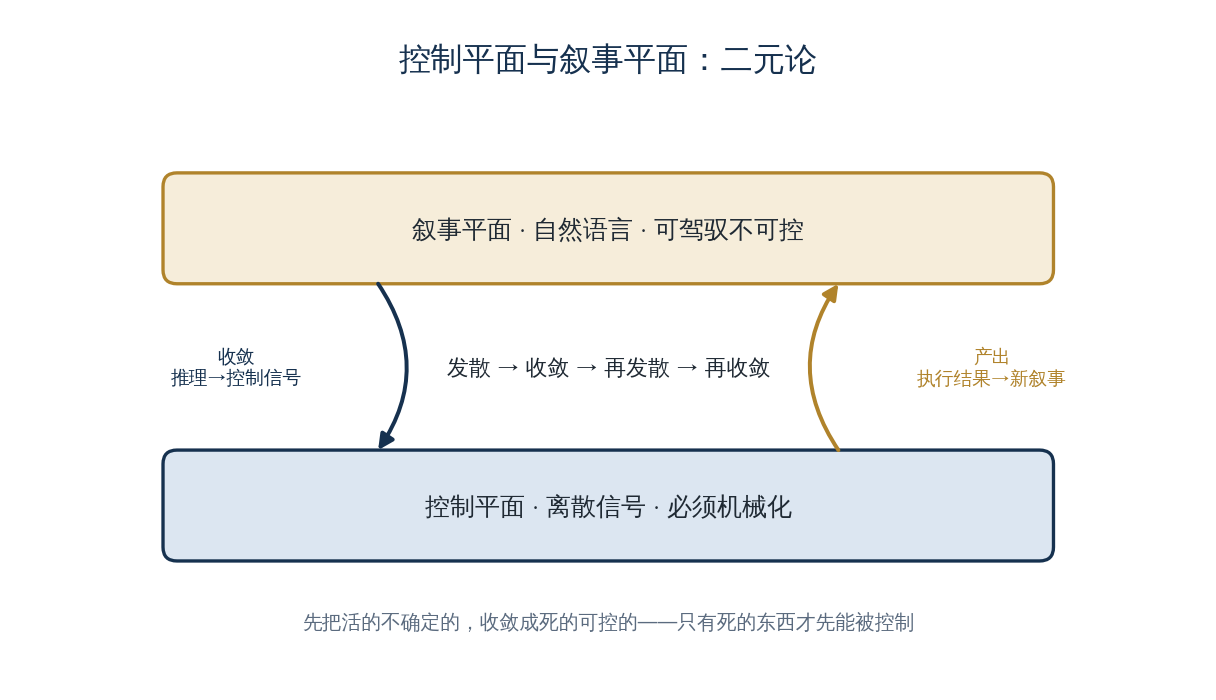
Application context
A payroll agent receives “create the Singapore payroll group from last month’s template.” The model can interpret the request and explain the intended result. The runtime still needs a finite route, exact tenant and template identifiers, approval state, and a deterministic branch for failure. Free-form language and program control serve different consumers.
Definition
The narrative plane contains model-readable goals, observations, explanations, and summaries. The control plane contains bounded values that select program branches: intent enums, node states, policy decisions, approval status, retry state, and error codes. Narrative helps the model reason. Control determines what the runtime is allowed to do next.
Engineering mechanism
| Plane | Typical data | Writer | Consumer |
|---|---|---|---|
| Narrative | Goal, evidence summary, current explanation | Model and application | Model, reviewer, UI |
| Control | task_type, node state, approval decision, reason code | Typed program logic or policy engine | Router, scheduler, guardrail |
The model may propose a control value, but a parser validates it against a finite schema and maps invalid output to an explicit fallback. Tool responses enter mechanical state before a narrative summary is produced.
Boundary
This separation does not remove language from execution. It prevents prose from becoming the sole authority for routing, approval, and recovery. Content-only work can use a thinner control plane; external writes require explicit control values and recorded transitions.
Proposal and provenance
- Concept group
- System boundaries and state
- Initial source within ADPS
- Initial practice: Bo Liang
- First recorded in
- Dongfang Yiteng execution-agent case ()
- ADPS editorial work
- ADPS named the separation between program control signals and model-readable narrative, then stated its boundary.
- Current standing
- ADPS restatement
Initial source: Dongfang Yiteng Execution Agent case report; contributed by Bo Liang.
Chronicle
- Recorded source
- Dongfang Yiteng execution-agent case ()
- Source date
- First published on ADPS