
Concepts/Concept
ADPS Engineering Concept Registry
Intent as Compilation
Translate open language into a validated, bounded control signal with an explicit fallback.
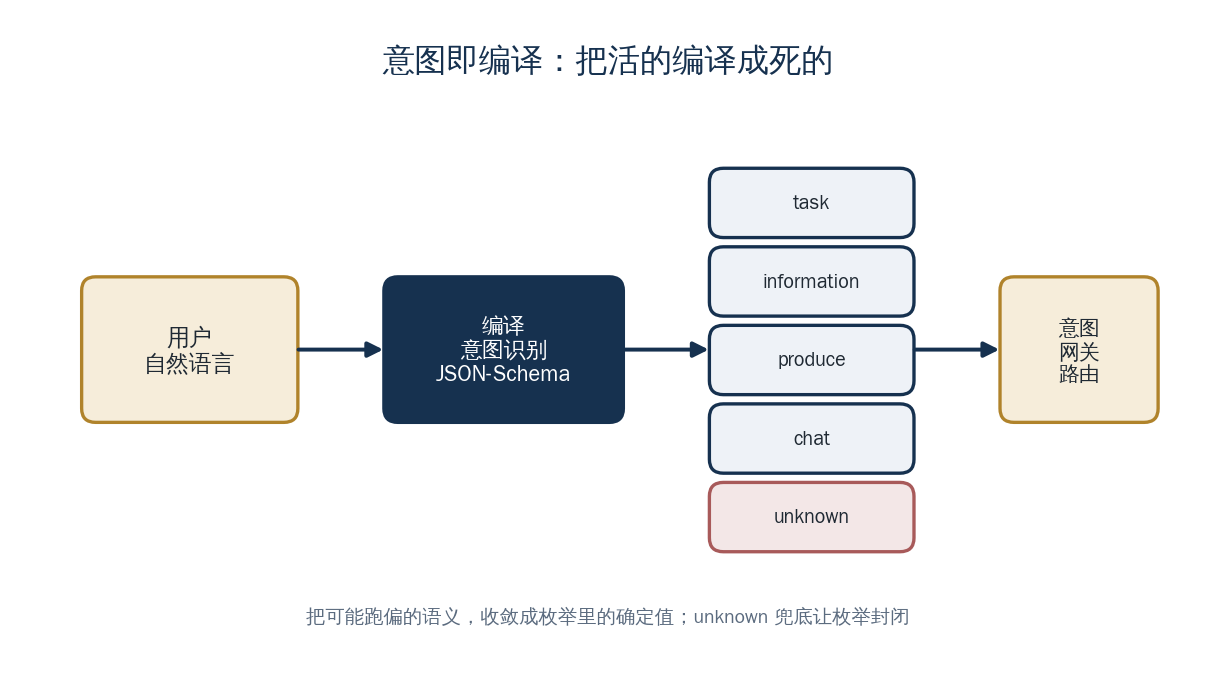
Application context
“Help me configure payroll” may mean a question, an analysis request, or an instruction to change the system. Sending all three into one open ReAct loop exposes unnecessary tools and makes approval boundaries unclear.
Definition
Intent as Compilation translates open language into a bounded control representation. The output contains a finite task class, extracted entities, confidence or ambiguity, required clarification, and the next permitted route. Invalid output becomes unknown; it does not fall through to a privileged default.
Engineering mechanism
message
  → classifier and entity extraction
  → schema validation
  → {task_type, entities, ambiguity, evidence_refs}
  → route policy
  → chat | analyse | resolve | clarify | reject
The vocabulary is derived from downstream capabilities. A new enum is added only when the runtime has a distinct contract, authority set, and acceptance path for it. The original message remains available as narrative evidence.
Boundary
The compiled intent is a routing signal, not proof that the user’s goal has been fully understood. Complex or high-risk work still requires a Context Contract, plan checks, and confirmation of the action before execution.
Proposal and provenance
- Concept group
- Planning, execution, and write-back
- Initial source within ADPS
- Initial practice: Bo Liang
- First recorded in
- Dongfang Yiteng execution-agent case ()
- ADPS editorial work
- ADPS restated the language entry point as a compiler front end with bounded enums and an unknown fallback.
- Current standing
- ADPS restatement
Initial source: Dongfang Yiteng Execution Agent case report; contributed by Bo Liang.
Chronicle
- Recorded source
- Dongfang Yiteng execution-agent case ()
- Source date
- First published on ADPS